Video Games |



|
Assassin's Creed II (2009)
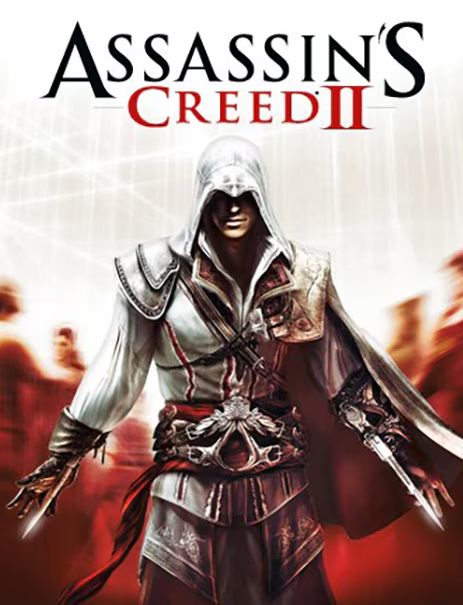
There is a particular kind of old magic that only shows up when a big-budget game is made with absolute sincerity, and then dragged—sometimes awkwardly—across a decade of changing hardware, storefronts, and operating systems. The PC version of lives squarely in that space. It is at once a Renaissance travelogue, a cyberpunk science fiction, a carefully paced coming-of-age story, and a reminder of how fragile great games can feel when preserved through imperfect ports.
Long before the series expanded into a sprawling historical anthology, Assassin’s Creed II understood something foundational: players do not fall in love with mechanics alone. They fall in love with places, with characters who grow inside those places, and with the feeling that the world would continue existing even if the player put the controller down. Italy in ACII is not a backdrop—it is a living, breathing stage that Ezio Auditore grows up on in full view of the player.
For the uninitiated, Assassin's Creed is known for mixing cyberpunk science fiction with ancient history. As with the first game in the series, AC-II follows the centuries old war between The Templars, a shadowy organization determined to control the flow of history, and the titular Assassin's Creed, a secret brotherhood of, well, assassins who exist to kill templars and thwart their plans. Simple enough, and a type of plot familiar from hundreds of novels, TV shows, films, anime, manga and graphic novels. Where Assassin's Creed differs is in the way it situates its plotlines and characters. Where most narratives either situate themselves in either the past or the future, Assassin's Creed as a series keeps one foot on each boat. Desmond Miles enters the Animus device that taps into his genetic memory, and allows Desmond to walk back in the footsteps of his assassin ancestor Ezio Auditore de Firenze. As Desmond relives Ezios life and adventures in his mind he rediscovers the secrets of the assassin's creed. Secrets that the Creed will use to stop the Templars in current time.
The game opens small and personal. Ezio begins as a young noble defined by confidence, charm, and a sense that life is fundamentally fair. What makes the early tragedy land is not its shock value but its aftermath. ACII lingers on loss long enough for it to feel destabilizing, and then asks a more interesting question than most revenge stories: what happens when vengeance stops being enough? Ezio’s arc unfolds gradually and convincingly. He is not “reborn” overnight into a stoic assassin. Instead, he matures in stages—reckless anger gives way to discipline, discipline gives way to reflection, and reflection slowly turns into responsibility. Many beloved protagonists remain static icons. Ezio becomes memorable because he changes, and because the game gives that change time to breathe.
As with the first, you'll begin the game in control of Desmond Miles who is still at Abstergo, his futuristic prison from the original. Desmond, this time round, has a much more emotive storyline, though his parts are shorter now. After some brief gameplay and storytelling, you'll hop back into the Animus - the virtual reality through which Desmond can control his ancestors - and take control of Ezio Auditore, an Italian member of Desmond's bloodline who lived during the Italian Renaissance. It's probably worth mentioning that Assassin's Creed is, and always was, intended as a trilogy and so the storylines do blend together, with more than one reference to the first's protagonist Altäir. By no means is the game unplayable without knowledge of the first, but to get full enjoyment of it'd be recommended you play the original.
The storyline follows several years of Ezio's life, from his early age as a brash and carefree youth to his later years as a thoughtful and cunning assassin. Ubisoft have really brought life to the characters involved in Assassin's Creed II, and it's definitely all the better for it. From the early missions, you care for Ezio and you enjoy playing as him. Altäir was a cool, calculated character, but it was never as involving to play as him through the entire game as it was from the opening scenes of Ezio's life. As a starter, we're given a reason for Ezio's fight against the Templars - rather than being thrust into an assassin's body, we see the motivation, the hidden agendas and the emotion behind it all. The story has become far more evolved and absorbing.Supporting characters reinforce this growth rather than overshadow it. Family members keep Ezio tethered to a human scale of loss and care, mentors are fallible rather than omniscient, and antagonists feel less like caricatures and more like logical products of a corrupt political order. Even the series’ famous conspiracy elements feel restrained here, grounded by an emotional core that never loses sight of personal cost.
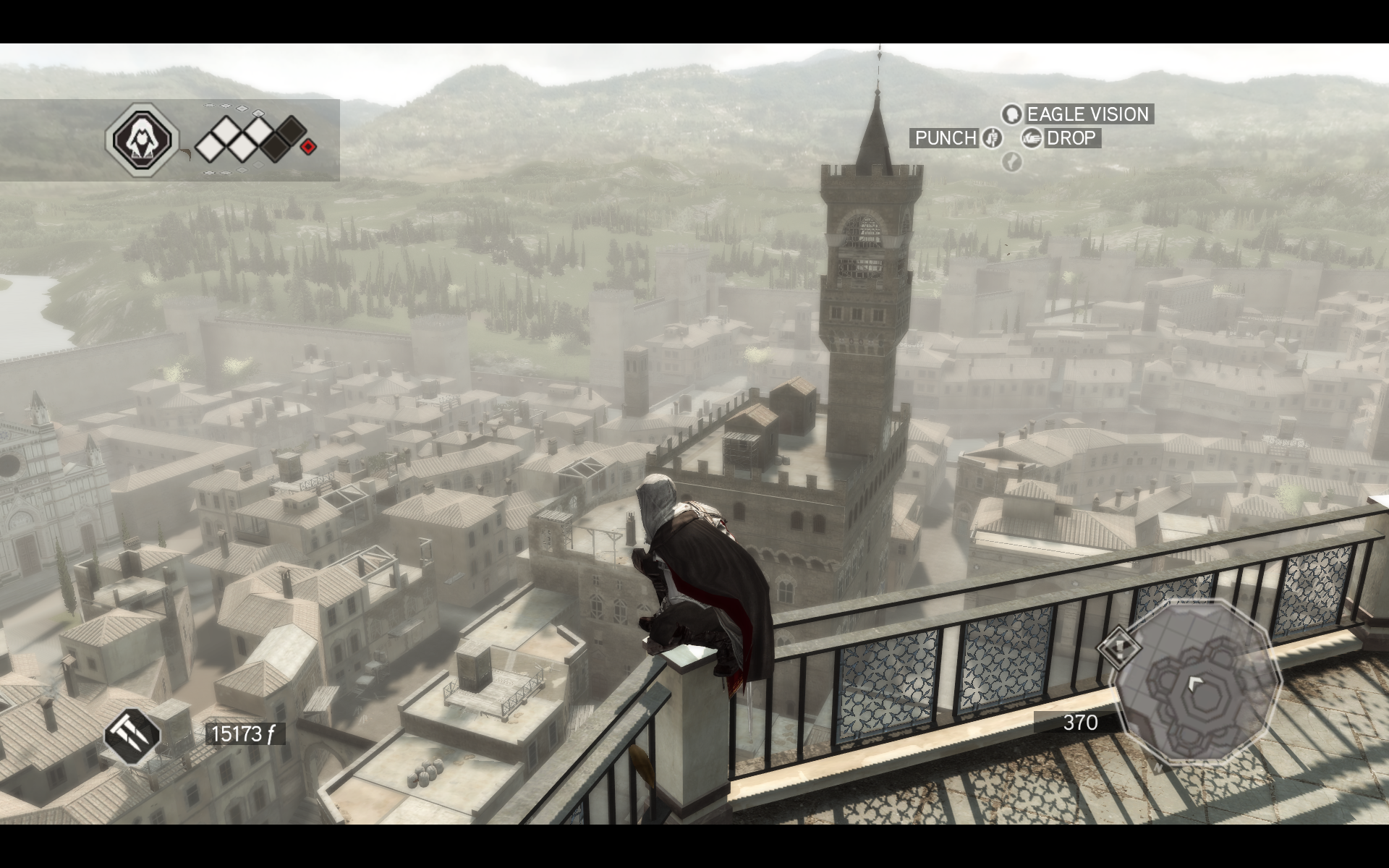
eyond that, the way the gameplay is structured has improved massively. No longer is it a case of being told who to kill and proceeding to the correct area to complete a few generic and repetitive side-missions which don't have any noticeable effect. Instead, the game runs through a mission-by-mission style, where even the simple missions are part of the story. You'll have a cut-scene, introducing characters and the mission and whilst some follow a simple pattern (escort missions, searching missions, etc.) each one is different. It's a much improved style, since it discards the repetition that came with the first. Often you'll be allowed to tackle a number of missions in any order before the final assassination mission becomes available - so the idea that you must prepare for the task, which the first insisted on thrusting upon us, is still there and relevant. It's just done in a masterful way. Nowhere is ACII’s confidence clearer than in its environments. Florence teaches the player the grammar of rooftops—angled tiles, predictable handholds, and fluid traversal that turns the city into a vertical playground. Venice shifts the rhythm entirely, introducing water, bridges, and dense crowds that force different movement and stealth strategies. Monteriggioni, the game’s hub, serves as an emotional anchor: rebuilding it mirrors Ezio’s own reconstruction after loss.
There are still side-missions to be completed, before those that enjoy that sort of thing rise up in anger, but there are fewer of them and they're never mandatory. This gives you a little extra to work at in-between missions, and with these and the collectables you'll have a number of goals to work towards should you wish it. Beyond this, there are extra improvements that add into the experience of the game that are necessary but are worthwhile. For example, there are a number of weapons you are able to use which you can pick up from fallen enemies, or purchase from a blacksmith. You'll earn florins throughout the game which can be spent at any of the stores. These involve customising your outfit with a variety of clothes dyes, the purchasing of armour or treasure maps to locate even more money. At one point in the game you'll also be given access to Villa Auditore which you can upgrade and buy new buildings for - restoring the villas lost beauty. This is more extra content that, whilst not necessary, is a welcome addition that adds to the whole experience.
As important all this is, ultimately it is the assassinations that matter. The first was flawed since each one followed a similar pattern - the places and people may have changed, but largely it was about getting as close as you can for a quick kill then racing back to a hideout for a successful mission. In this case, the assassinations are far more fluid events. Some will be specific, pre-scripted missions - such as chasing a character down or being forced into a fight - while others give you a little more freedom of what you do. It never really feels like you're being told what to do; since the game follows so closely to mission-based storytelling, when you come to the assassination you deal with it how you can, rather than getting upset at your plan not happening as you would have liked.
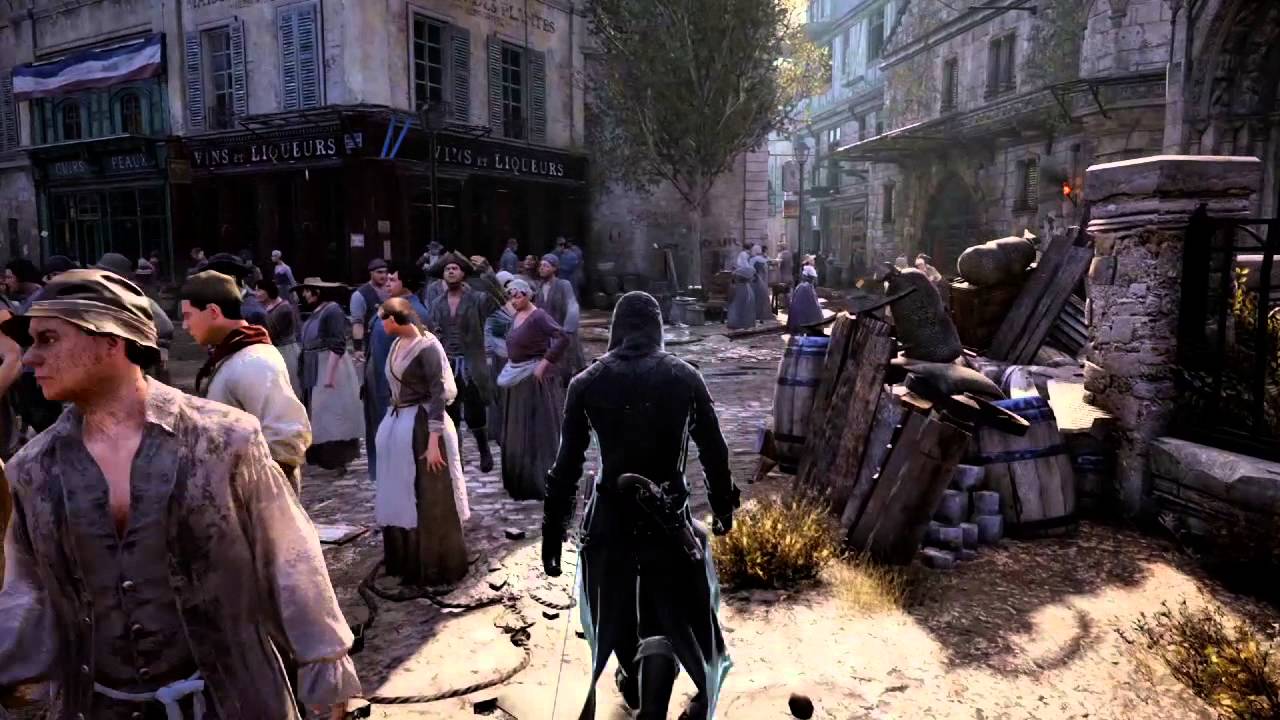
The games does shine, in a very mid-2000s way, in the way it presents its world These cities are not interchangeable skins. Each has a distinct pace, texture, and social logic. The narrow alleys, grand plazas, and skyline silhouettes subtly communicate class, power, and history. This environmental storytelling—so often praised by long-form player retrospectives—does not rely on exposition. It trusts the player to absorb meaning simply by moving through space.
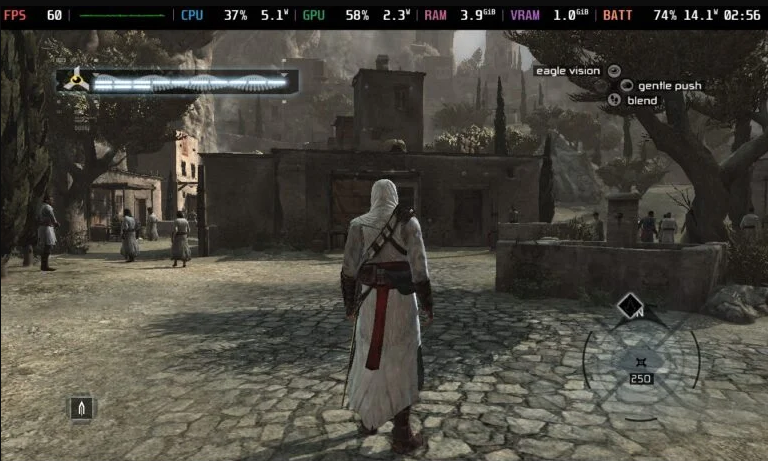
But all is not sunshine and roses. Combat and stealth, viewed today, are unmistakably products of their era. Sword fights can feel stiff, counter-heavy, and occasionally theatrical to a fault. Stealth relies more on social blending and line-of-sight than on the surgical precision expected from modern stealth titles. Yet even here, the systems serve the tone. ACII wants you to feel like a public ghost—visible, confident, and dangerous in plain sight.
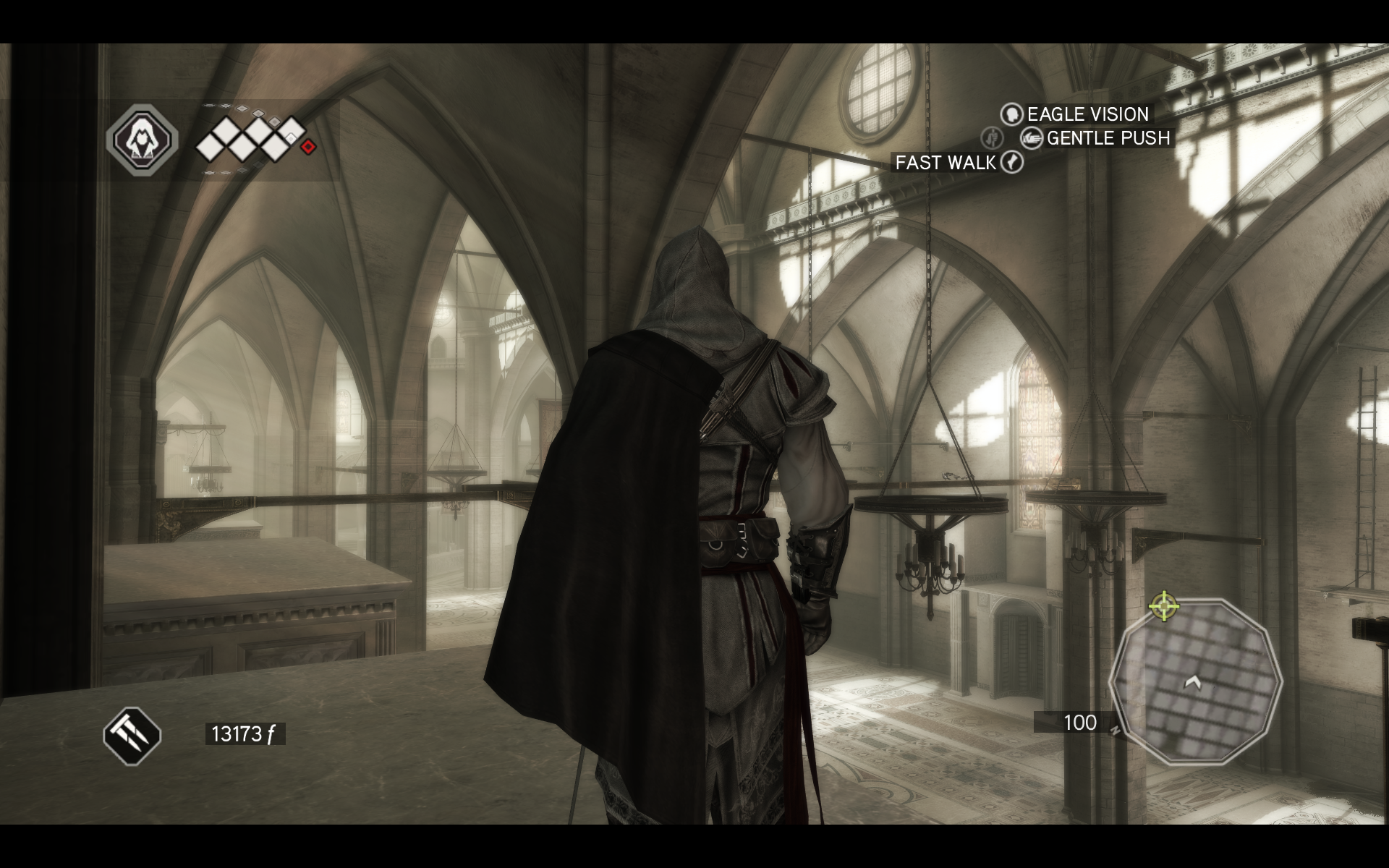
And then there is the dreaded mid-2000s bad console-to-PC-port issue. The game stumbles in mechanics just about as badly as it excels in world and character building. The port carries well-known issues, particularly around input handling and controller support. Depending on hardware and configuration, controller behavior can feel inconsistent, with misread triggers, awkward mappings, or inputs that simply do not align with player expectations. At the best of times this means Ezio will jump off a wall when you are trying to get him to creep along. At the worst of times this becomes a life and death issue as Ezio parries out of sync or simply refuses to strike when you desperately need him to.
For many players, achieving usable controller support requires experimentation. In some cases, enabling Steam Input helps by translating modern controllers into something the game can reliably interpret. In other setups, Steam Input actively interferes, making it necessary to disable it and rely on native or community-fixed mappings instead. The frustrating truth is that there is no universal solution—only trial, error, and community wisdom.
This inconsistency is emblematic of older PC ports. Assassin’s Creed II was never built with today’s layered input ecosystems in mind, and it shows. When the controls misbehave, the illusion breaks. The player becomes aware of software boundaries rather than inhabiting Ezio’s physicality. It is the single greatest obstacle preventing the PC version from being the definitive way to experience the game.
Yet when everything aligns—when input is stable and the game’s rhythm takes over—ACII reminds you why it became the emotional benchmark for the series. Rooftop runs at sunset, synchronized viewpoints revealing sprawling cityscapes, and quiet narrative beats all work together to produce a sense of historical presence few games have matched.
More than anything, Assassin’s Creed II endures because it understands inheritance. It is a story about what is passed down—names, debts, ideals, and mistakes—and about choosing what to carry forward. The Renaissance setting is not ornamental; it is a constant reminder that power leaves traces, and that those traces shape the moral terrain of the future.
As a PC experience, Assassin’s Creed II demands patience. You may need to wrestle with controller settings, tolerate occasional jank, and accept that this is a preserved artifact rather than a modernized remake. But for players willing to meet it on its own terms, the reward is substantial: a richly textured world, a genuinely evolving protagonist, and a story that trusts time, place, and character to do the heavy lifting.
In the end, the PC port is imperfect—but the game beneath it remains quietly extraordinary. Assassin’s Creed II is not remembered because it was flawless. It is remembered because it was felt.
Max Payne (2001)
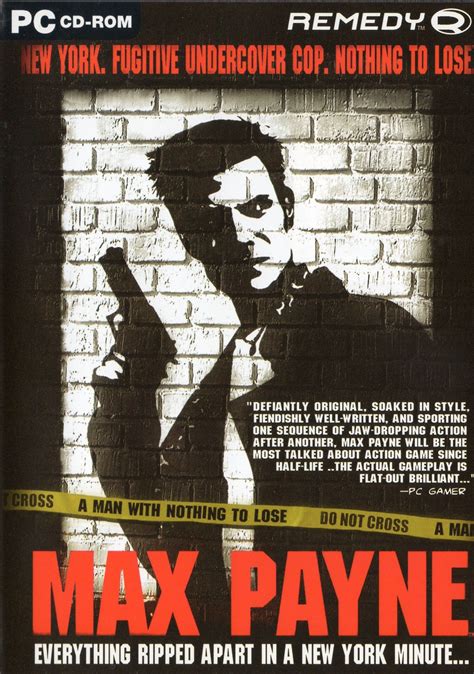
Coming soon...